When Catholics think about praying, we often think about using words and gestures. For instance, our prayers usually begin and end with the Sign of the Cross, which involves both speech and physical action. In the sacramental life, however, the Church acknowledges that there are other components beyond words and actions that help us enter more deeply into the mysteries of our faith, such as sacred music, architecture, art, and time.
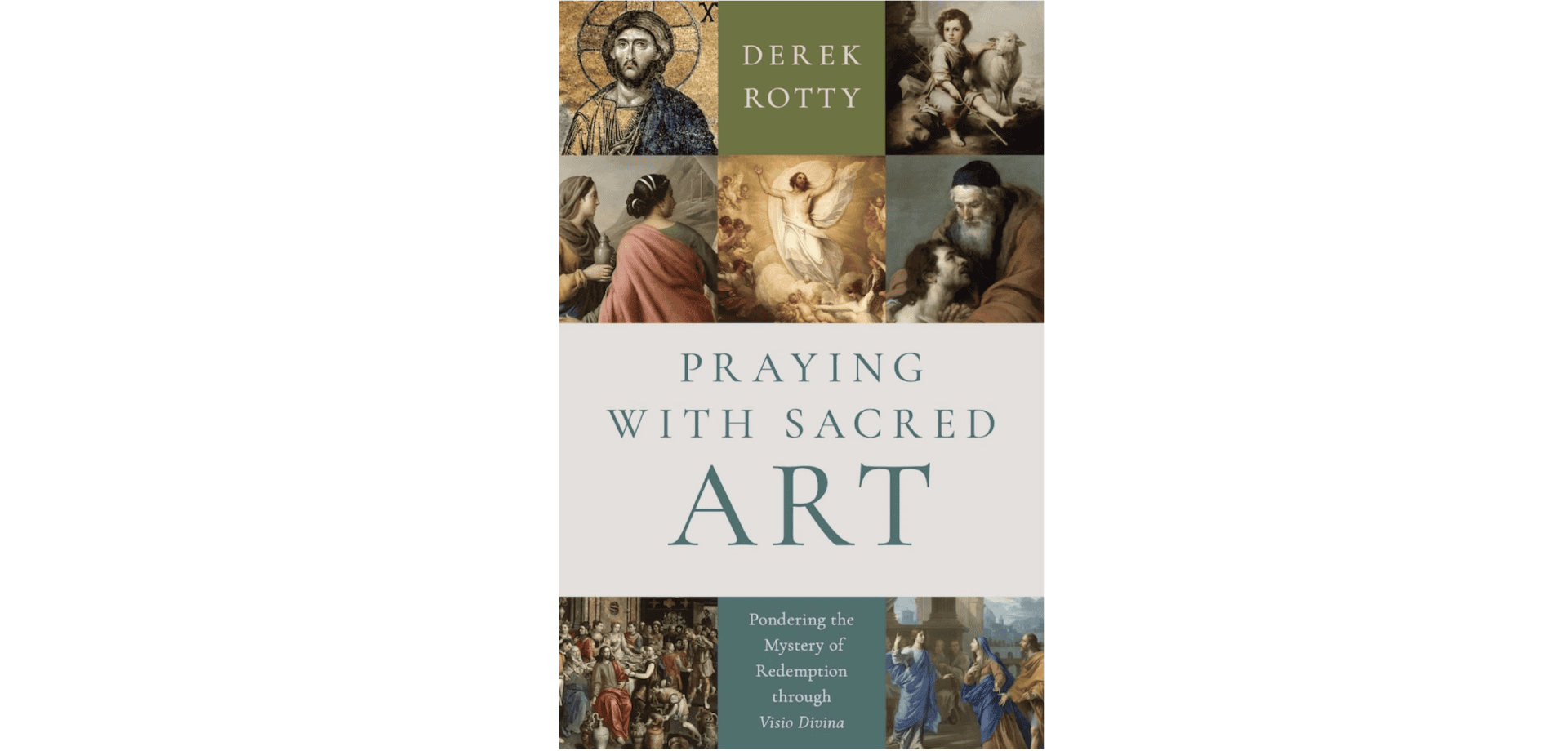
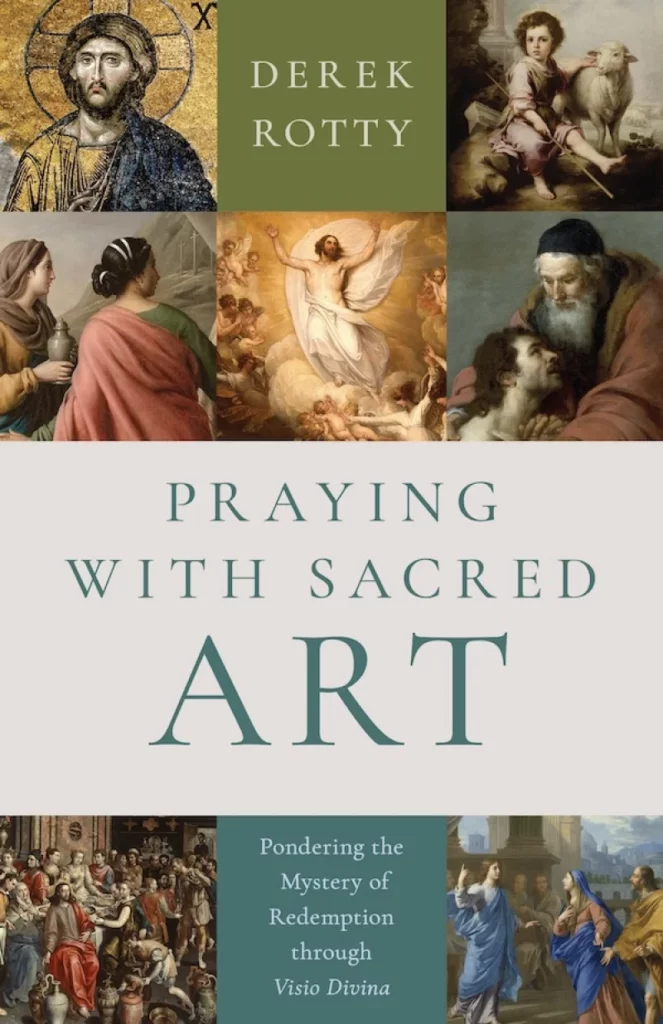
Derek Rotty’s book, Praying with Sacred Art: Pondering the Mystery of Redemption through Visio Divina, highlights the importance of encountering God through iconography and artistic depictions of biblical themes. Rotty, a convert to Catholicism, freelance author, husband, and father of five, provides thoughtful examples of how to apply the ancient monastic practice of lectio divina (a four-step method of praying with Scriptures or spiritual texts) in reading sacred art. This adapted method he calls visio divina.
The book comprises 228 pages, consisting of an introduction, six parts based on the liturgical year and themes centered on the life of Christ, and an epilogue. It features 30 short essays that serve as meditations on artistic portrayals of scriptural events or mysteries. Rotty narrows the scope of these art pieces to paintings due to a practical limitation—“simply because of the two-dimensional format of a book”—while acknowledging that three-dimensional art, such as sculpture, could also serve as objects for meditation using visio divina (6). Each of these essays is between four and six pages in length. Rotty’s expressed goal in writing them is “to allow the piece of art to serve as a window into the viewer’s soul” (6).
Encountering God
In his introduction, Rotty takes as his starting point Pope Benedict XVI’s emphasis on the priority of encountering God. Rotty states, “To foster this necessary and beautiful encounter, we must believe that God continues to speak” (3). He enumerates four ways in which God communicates to us even in our time: through the Church, the Scriptures, our desires, and through beauty.
While we often associate art with the last of these—beauty—Rotty admirably appeals to all four ways in his reading of sacred art. Moreover, the depth of his writing demonstrates a very personal component, as he states, “This book is the result of my own visio divina, my own practice of gazing on art and prayerfully asking God to change my soul through the window of my sight” (7).
The book is divided into six parts, following the liturgical seasons and important events in the life of Christ. Part One deals with Advent (10-44), Part Two with Christmas and Jesus’ childhood (46-74), Part Three with Lent and Holy Week (76-116), Part Four with Easter (119-158), Part Five with Jesus’ public ministry (160-189), and Part Six with Jesus’ parables and miracles (192-214). Each of these parts consists of four to seven artwork-centered essays. The book concludes on an eschatological note with the epilogue, meditating on an image of Christ Pantocrator (“Ruler of All”) surrounded by saints in heaven.
All of these sections highlight the primacy of the liturgy in Rotty’s choice of artwork. In fact, each part features paintings and icons corresponding to certain lectionary readings from various liturgical seasons. While the works of art themselves take center stage, Rotty attentively reads them in the context of the season and always with their corresponding scriptural texts, ensuring a robustly canonical interpretation.
At times, Rotty even provides relevant passages from magisterial documents, such as conciliar texts and papal writings. These additions underscore the fact that we do not meditate on sacred art (or the passages upon which they are based) merely in a personal way but as members of the Church, with the guidance of the Magisterium. Indeed, Sacred Scripture and Sacred Tradition form one sacred deposit of the word of God, committed to the Church (Dei Verbum, 10), and this reality also applies to the reading of biblical portrayals.
God Is in the Details
Praying with Sacred Art strikes a good balance between looking at the big picture of salvation history and the liturgical year while also paying attention to the small details of the artwork. Indeed, Rotty points out subtle visual elements in the paintings and icons that can easily go unnoticed, such as details in the background, the use of colors, the direction of people’s gaze, and the composition of the pieces.
Rotty uses his admirable attention to detail to nudge the reader to ponder deep questions. He demonstrates how each aspect of the paintings can provoke self-examination regarding our relationship with God, the Church, and society in general. The author thus helps us understand that each depicted scriptural event remains relevant today and demands crucial life choices from us. Rotty’s careful consideration of sacred art, then, is not ordered toward mere artistic appreciation but toward the rediscovery of the transforming power of God’s message. The very first chapter, “The Eve of the Deluge,” exemplifies this point by jolting the reader to wake up from passive stupor to prepare for the Lord’s coming—a reality that is not only true during Advent but every day of our lives.
One of the biggest strengths of the book is its appeal to sacred art from various eras, styles, and provenances. Taking from both the East and the West, the book features Byzantine icons as well as paintings from the Renaissance, Baroque, Romantic, and other periods.
Rotty has also carefully chosen artists from different places of origin, including Spanish (Juan Fernandez de Navarrete, Goya, and Bartolome Esteban Murillo), Danish (Carl Bloch), Dutch (Gerard van Honthorst, Rembrandt, and Matthias Stom), Flemish (Peter Paul Rubens, Philips Immenraet, and Anthony van Dyck), Italian (Mattia Preti, Lavinia Fontana, Orazio de Ferrari, Caravaggio, and Raphael), French (Philippe de Champaigne, Irma Martin, and Jacques Tissot), Scottish (William Bell Scott), and American (Henry Ossawa Tanner and Benjamin West). While the works that appear in the book could be more varied, it is clear that the author has taken great care in choosing the pieces of sacred art that can help him (and us) to pray and see our place in salvation history.
A Matter of Application
Rotty’s use of sacred art from various times and places highlights the fact that praying with iconography is not new in the life of the Church. However, since today’s society is barraged and overstimulated by images from the internet, more and more of which are AI-generated, it is very helpful to see a Catholic writer model ways we can slow down and enter more deeply into the saving events of our faith by meditating on real, human-made, and prayer-filled iconography, in conjunction with scriptural texts and magisterial writings.
Praying with Sacred Art thus serves as a good beginner’s guide on how “to do” visio divina. Rotty does so by providing examples, though a more explicit explanation of the steps and methods would have been helpful. Lectio divina, the prayerful reading of Scripture or spiritual texts, usually involves four “steps.” It would also have been useful to hear about the steps that one can take in “reading” sacred images and icons, as well as how to choose suitable artwork for meditation.
While determining what counts as “sacred art” is undoubtedly a large topic, some guidance on this matter, however brief, could be of greater help to readers in evaluating the spiritual value of biblical depictions. Indeed, Eastern iconography is known to have clearer canonical and traditional standards for the depiction of Christ and the saints, while in the West, there has been greater freedom and variety in religious artistic portrayals, which means that not every biblically-themed painting is appropriate for use in prayer and worship.
Overall, Rotty provides a very thoughtful and prayerful book with sublime images and numerous questions that draw readers into the saving events of our faith. It can be used to enter more deeply into the Church’s cyclical liturgical seasons. As with lectio divina, Praying with Sacred Art is meant to provide a way to pray—and should be relished slowly and without rush—a reminder in our frenetic world to be generous with our time in praying and encountering the loving God who continues to communicate with us.